
Tilly vs Klaviyo
Klaviyo sends your email and SMS; Tilly writes what it sends, and most stores use both. Tilly runs your email, ads, SEO, AI search and store pages as one loop: flows and campaigns go into Klaviyo as drafts, nothing goes out until you approve it, and what each email earned shapes the next one. Below: who does what, what each costs, and when Klaviyo alone is enough.
The short answer
Most stores do not need to choose. Klaviyo sends your email and SMS; Tilly writes what it sends.
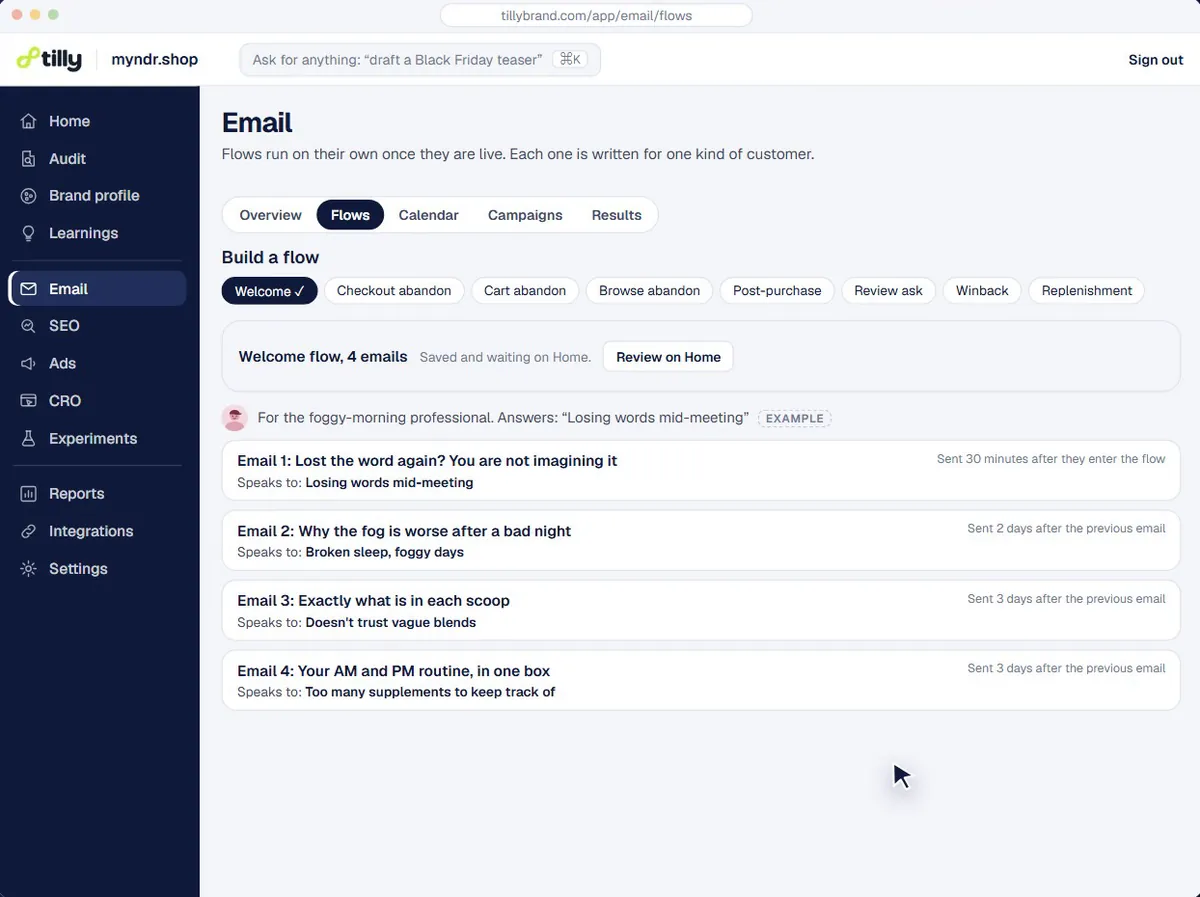
Keep Klaviyo on its own if someone already writes your emails. Add Tilly if your flows were set up once and never touched, or your campaigns wait for someone to find the time. Tilly reads your product pages and reviews, works out who buys from you and what stops them, and writes your welcome, abandoned cart, post-purchase and winback flows and a month of campaigns for those people, saved in Klaviyo as drafts for you to switch on. Every night it reads what each email earned and writes the next one with what worked, and it does the same for your blog, ads and product pages. Try the free audit: paste your store URL and see in about a minute what Tilly would fix first.
What Klaviyo is
Klaviyo is an email and SMS platform for online stores, rated 4.7 out of 5 on its Shopify listing. source, checked 25 September 2026
You build the flows and campaigns yourself inside Klaviyo. New stores get a guided setup for a sign-up form, a welcome email and an abandoned-checkout flow, and Composer drafts campaigns across channels. It sends email, SMS, WhatsApp and mobile push, runs pop-ups, and connects to more than 350 other apps.
What each one does
Each app’s cells come from its own Shopify listing or pricing page, linked beside the words. “Not listed” means we did not find it there, not that the app cannot do it. Tilly’s column is our own product.
| The job | Tilly | Klaviyo |
|---|---|---|
| Email and messaging | ||
| Email flows | Writes 8 flows, saved to Klaviyo as drafts | Yes, with a guided setupsource |
| Email campaigns | Writes them, saved to Klaviyo as drafts | Yessource |
| SMS or WhatsApp | No | SMS and WhatsAppsource |
| Push notifications | No | Mobile pushsource |
| Sign-up pop-ups | No | Yessource |
| Products in emails | A featured product or a product carousel, from your catalogue | Not listed |
| SEO and AI search | ||
| SEO blog posts | Writes and publishes them to your Shopify blog | Not listed |
| SEO audit and rankings | Free audit; rankings from Search Console | Not listed |
| SEO fixes | Titles, descriptions and alt text, applied when you press Apply | Not listed |
| AI search visibility | Asks AI assistants your buyers’ questions every week | Not listed |
| Ads | ||
| Meta ads | Writes and makes them; published paused | Not listed |
| Google ads | Writes a search ad; published paused | Not listed |
| Reads past ad results | Reviews the last 30 days of your Meta account | Not listed |
| Store pages and tests | ||
| Store page fixes | Writes the fix for each page issue | Not listed |
| A/B tests | Plans and sizes them, calls the winner; does not split traffic | Not listed |
| Results and control | ||
| Reports | Blended ROAS and MER from Shopify, Meta and Google, every morning | Not listed |
| Learns from results | Every night, and carries a winner across channels | Not listed |
| Tracks changes to your store | Every six hours, read only | Not listed |
| Waits for your approval | Always: nothing goes live without it | Not listed |
| Connects to | Shopify, Klaviyo, Meta, Google Ads, Search Console, Google Analytics | 350+ appssource |
Side by side
The Klaviyo column comes from Klaviyo's own pricing page and its Shopify App Store listing, each cell linked to the page it was read from. Anything Klaviyo does not publish on those pages is left empty rather than estimated.
| Side by side | Tilly | Klaviyo |
|---|---|---|
| Lowest published paid plan | Store: $49/month | Email: $20/month, 251-500 contactssource |
| What the price is based on | Credits spent when an agent builds something; not contacts, sends or ad spend | Not recorded |
| Free plan or trial | 100 credits, once; on a website sign-up they arrive after a card is saved (it is not charged) | Free up to 250 active profiles and 500 email sends a monthsource |
| Shopify App Store rating | Not recorded | 4.7 out of 5source |
| Connects to | Klaviyo (draft flows and campaigns), Meta (paused ads), Google Ads (a paused search ad) and Shopify (SEO titles, descriptions and alt text you apply, and blog posts, hidden unless you choose live) | 350+ integrationssource |
| Approval before anything goes live | Never. Every email, post, ad and page change waits for approval | Not recorded |
What each costs
The two are priced on different things, so a single number per store size would mislead. Klaviyo charges by the contacts you keep and the messages you send: the free plan stops at 250 active profiles and 500 email sends a month, and its Shopify listing starts paid email at $20 a month for 251 to 500 contacts. Klaviyo's pricing page sets larger lists with a slider, and we could not read a published price for a mid-sized or large list from it, so those are not shown.
Tilly charges for what gets built, not for your list. The Store plan is $49 a month for 500 credits; an email flow costs 30 credits and a campaign 10, while audits, previews and reports cost nothing. Because Tilly writes into Klaviyo rather than replacing it, a store using both pays both bills, and should compare Tilly's cost with the hours or agency fees it takes today to get the emails written.
The last table prices the same store on both. Two emails a month to 250 people is 500 sends; a weekly email to 500 people is about 2,200. Flows send on top of campaigns, SMS costs extra on every app, and bigger lists cost more on all of them, so check each app’s own calculator for your exact figure. Yozo prices by emails sent; Klaviyo, Omnisend and Mailchimp by contacts; Enrich Labs and Tilly write for Klaviyo rather than send.
| Klaviyo's published plans | Price |
|---|---|
| $20/month, 251-500 contactssource | |
| SMS | $15/month, up to 1250 SMS/MMS creditssource |
| Tilly's plans | Price |
|---|---|
| Start | $0, 100 credits, once, good for 30 days |
| Store | $49/month, 500 credits every month |
| Growth | $149/month, 2,000 credits every month |
| Agency | $399/month, 6,000 credits every month, shared across clients |
| What the same store pays | 250 contacts, two emails a month | 500 contacts, a weekly email |
|---|---|---|
| Klaviyo | $0: free up to 250 active profiles and 500 sends a monthsource | $20 a month: email for 251 to 500 contactssource |
| Tilly + Klaviyo | $0: 100 free credits once (a flow is 30) and Klaviyo’s free plan | $99 a month: Tilly Sales Starter at $79 for 500 credits, plus Klaviyo at $20 |
Where Klaviyo is better
These are things Klaviyo does that Tilly does not do at all. source, checked 25 September 2026
- Klaviyo sends. Email, SMS, WhatsApp, mobile push and pop-ups all go out from one account, and Tilly sends none of them.
- It is an established sender for Shopify stores, with a 4.7 rating on the Shopify App Store when we checked and 350+ integrations to plug into.
- New stores get a guided setup inside Shopify Admin, with a sign-up form, a welcome email and an abandoned-checkout flow, before writing anything themselves.
- It connects to far more tools. Klaviyo lists 350+ integrations; Tilly connects to Klaviyo, your Shopify blog and Meta.
Where Tilly is better
Tilly starts before the first email. The free audit reads your storefront, reviews and existing marketing and builds personas from them, and every flow it writes is aimed at one of those personas and one of their worries. A welcome flow for a cautious first-time buyer argues differently from one for a returning gift buyer, and that difference is the part most stores never get round to writing.
It learns from your own results. Every night it reads what each email, ad, post and page change earned, keeps the patterns your numbers back up, and writes the next piece with them, so a winning ad angle can become an email subject line and a product-page headline. Klaviyo reports how each email did; Tilly reads those results back, keeps what they prove and writes the next flow, ad and page with it. (How the loop works.)
Two more things sit in the same place: Tilly asks AI assistants the questions your buyers ask and shows whether they name your store or a competitor (more on AI search), and it keeps a record of every edit to your theme, products, pages and menus, so a change in sales can be read against what changed.
The same brand profile drives eight agents. The email agent writes into Klaviyo, the SEO agent publishes posts to your Shopify blog, the ads agent sends creative to Meta paused, and the CRO agent puts page fixes on a preview copy of your theme. The claims, the voice and the personas are the same in all of them, because they come from one place.
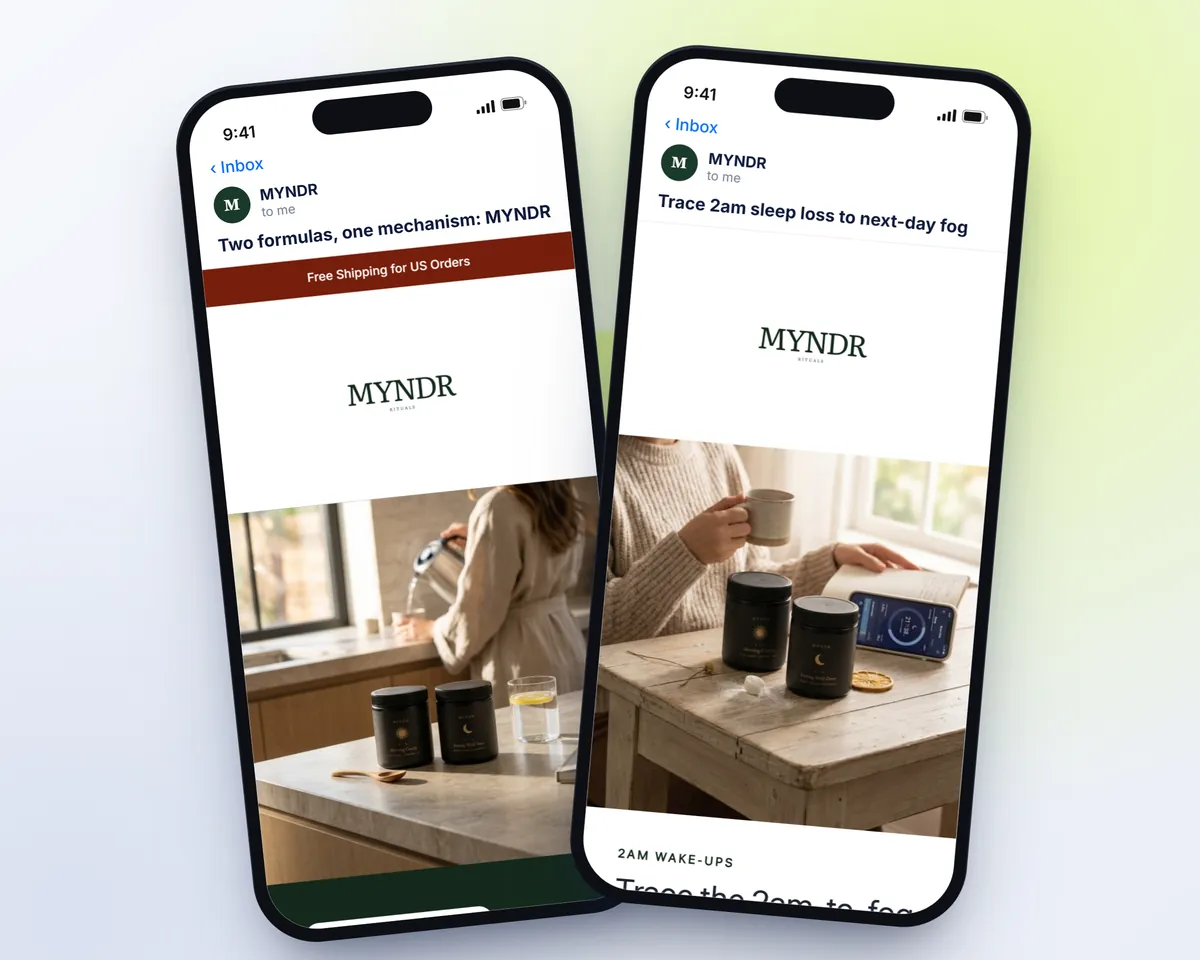
Nothing goes live without you. Tilly's flows land in Klaviyo as drafts and wait there. Klaviyo stays the system that sends, and you keep every switch.
Switching
There is no switch to make. Your list, consent records, sending domain and history stay in Klaviyo. You connect Klaviyo to Tilly, and new flows and campaigns appear in your account as drafts for you to read and turn on.
What Tilly cannot push to Klaviyo on its own: flows that start from a segment, from a date on the customer record such as a birthday, or from days since the last order. Klaviyo's API does not let an app create those, so Tilly gives you the emails and you build that flow in Klaviyo's editor.
Time needed is an afternoon for most stores: run the audit, confirm the personas, read the welcome flow it writes, then connect Klaviyo and publish it as a draft. Compare it with the one you send now before switching anything on.
A fair test is to leave your current welcome flow running for new subscribers from one sign-up form and point a second form at Tilly's version, then compare placed orders per recipient after a few weeks. Klaviyo reports both, so the judgement uses Klaviyo's own numbers rather than ours, and the losing flow can simply be switched off.
Questions people ask
Does Tilly replace Klaviyo?
No. Tilly writes emails and flows; Klaviyo sends them. You keep Klaviyo, your list and your sending history, and Tilly works inside it.
Can I stay on Klaviyo's free plan and use Tilly?
Yes, while your list fits inside Klaviyo's free limits of 250 active profiles and 500 sends a month. Past that, Klaviyo's own paid plans apply whether or not you use Tilly.
Will Tilly's drafts overwrite the flows I already have in Klaviyo?
No. They arrive as new draft flows. Your existing flows keep running until you decide otherwise.
Sources
- Klaviyo: klaviyo.com/pricing, checked 25 September 2026
- Klaviyo: apps.shopify.com/klaviyo-email-marketing, checked 25 September 2026
Spotted a price or fact that has changed? Report an error.
See this on your own store
Paste your store URL. The first pass takes about a minute and needs no account. Save a card (nothing is charged) and Tilly reads the whole store and works out who buys from you.