
Tilly vs Mailchimp
Mailchimp is an email sender with an editor, templates and a contact list. Tilly runs your email, ads, SEO, AI search and store pages as one loop, writing for the customers who actually buy, publishing into Klaviyo once you approve, and learning from every send. Below: how little they overlap, what each costs, and when Mailchimp is the better fit.
The short answer
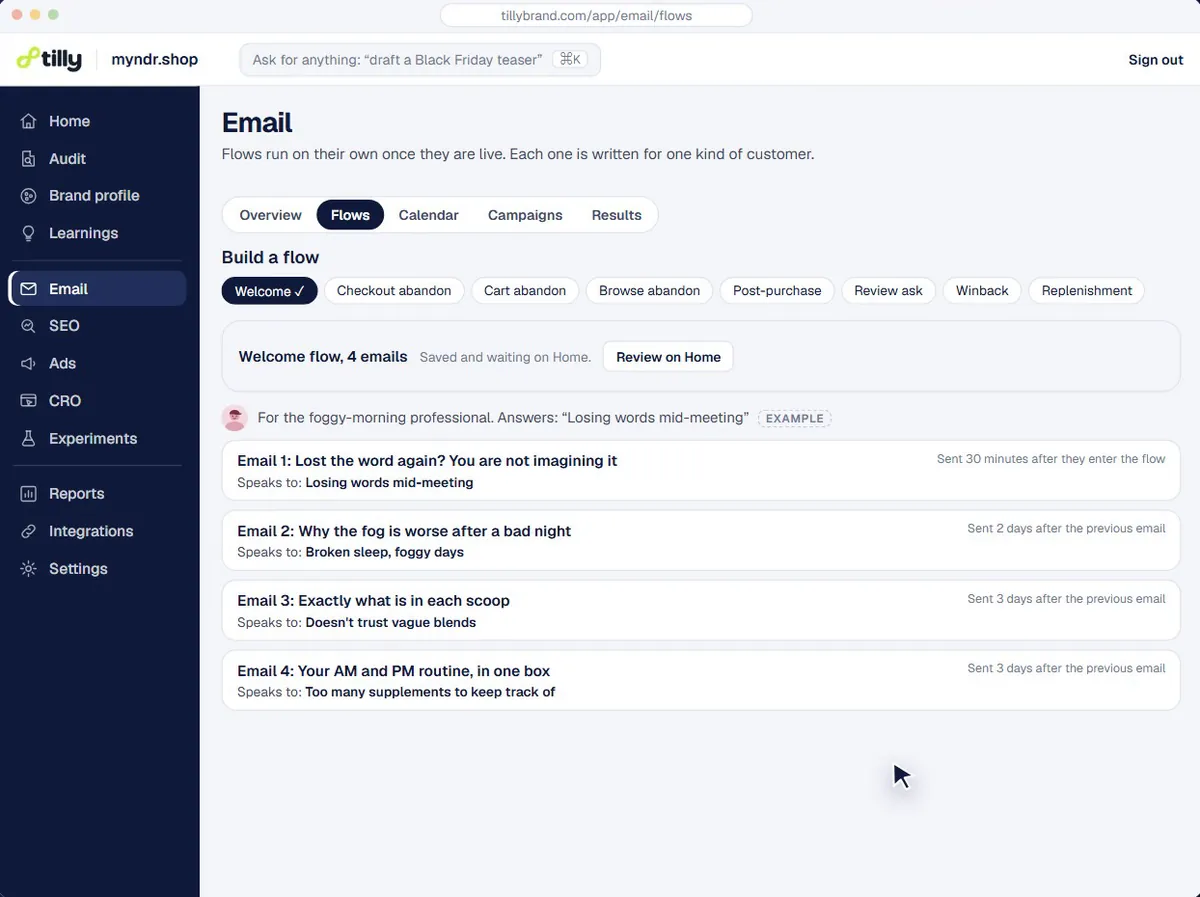
Mailchimp is a sender: you write the emails and build the automations, with up to 4 automations on its Essentials plan. Tilly writes them, and publishes into Klaviyo rather than Mailchimp.
Stay with Mailchimp if a regular newsletter and a few automations are all you need. Move to Klaviyo with Tilly if you want your emails written for you. Tilly reads your product pages and reviews, works out who buys and what stops them, and writes your welcome, abandoned cart, post-purchase and winback flows for those people, saved in Klaviyo as drafts. Every night it checks what each email earned and writes the next one with what worked, and it writes your blog posts, ads and page fixes from the same picture of your buyers. Try the free audit: paste your store URL and see in about a minute what Tilly would fix first.
What Mailchimp is
Mailchimp is an email marketing platform, rated 4.8 out of 5 on its Shopify listing. source, checked 25 September 2026
You build emails and automations yourself, including welcome, abandoned cart and back-in-stock emails, with SMS as a paid add-on and 300+ integrations on every plan. The plan decides how much automation you get: up to 4 automations on Essentials and up to 200 on Standard, which has a 14-day free trial.
What each one does
Each app’s cells come from its own Shopify listing or pricing page, linked beside the words. “Not listed” means we did not find it there, not that the app cannot do it. Tilly’s column is our own product.
| The job | Tilly | Mailchimp |
|---|---|---|
| Email and messaging | ||
| Email flows | Writes 8 flows, saved to Klaviyo as drafts | Yessource |
| Email campaigns | Writes them, saved to Klaviyo as drafts | Yessource |
| SMS or WhatsApp | No | Paid add-onsource |
| Products in emails | A featured product or a product carousel, from your catalogue | Not listed |
| SEO and AI search | ||
| SEO blog posts | Writes and publishes them to your Shopify blog | Not listed |
| SEO audit and rankings | Free audit; rankings from Search Console | Not listed |
| SEO fixes | Titles, descriptions and alt text, applied when you press Apply | Not listed |
| AI search visibility | Asks AI assistants your buyers’ questions every week | Not listed |
| Ads | ||
| Meta ads | Writes and makes them; published paused | Not listed |
| Google ads | Writes a search ad; published paused | Not listed |
| Reads past ad results | Reviews the last 30 days of your Meta account | Not listed |
| Store pages and tests | ||
| Store page fixes | Writes the fix for each page issue | Not listed |
| A/B tests | Plans and sizes them, calls the winner; does not split traffic | Not listed |
| Results and control | ||
| Reports | Blended ROAS and MER from Shopify, Meta and Google, every morning | Not listed |
| Learns from results | Every night, and carries a winner across channels | Not listed |
| Tracks changes to your store | Every six hours, read only | Not listed |
| Waits for your approval | Always: nothing goes live without it | Not listed |
| Connects to | Shopify, Klaviyo, Meta, Google Ads, Search Console, Google Analytics | Not listed |
Side by side
Mailchimp's figures are taken from its marketing pricing page and its Shopify App Store listing, with a source link on every cell. Where Mailchimp prices by a contact slider we show the published starting prices only. The rating rows show Mailchimp's figures alone. Tilly has no rating of its own quoted here.
| Side by side | Tilly | Mailchimp |
|---|---|---|
| Lowest published paid plan | Store: $49/month | Essentials: from $13/monthsource |
| What the price is based on | Credits spent when an agent builds something; not contacts, sends or ad spend | Not recorded |
| Free plan or trial | 100 credits, once; on a website sign-up they arrive after a card is saved (it is not charged) | Free under 250 contactssource |
| Shopify App Store rating | Not recorded | 4.8 out of 5source |
| Connects to | Klaviyo (draft flows and campaigns), Meta (paused ads), Google Ads (a paused search ad) and Shopify (SEO titles, descriptions and alt text you apply, and blog posts, hidden unless you choose live) | 300+ integrations on every plansource |
| Approval before anything goes live | Never. Every email, post, ad and page change waits for approval | Not recorded |
What each costs
Mailchimp is free under 250 contacts. Its Shopify listing gives starting prices of $13 a month for Essentials, $20 for Standard and $350 for Premium, each rising with contacts, and a 14-day free trial of Standard. The plans differ in more than price: Essentials allows up to 4 marketing automations and Standard up to 200, and monthly sends are capped at a multiple of your contacts, from 10X on Essentials to 15X on Premium.
Tilly starts with 100 free credits and no card, then $49 a month for 500 credits on the Store plan. Credits are used when an agent builds something: 30 for a flow, 10 for a campaign, 15 for a blog post. Looking costs nothing, including the audit, previews and reports.
Because Tilly does not send, a store using it still pays a sender. Today that sender needs to be Klaviyo for Tilly to publish directly.
The last table prices the same store on both. Two emails a month to 250 people is 500 sends; a weekly email to 500 people is about 2,200. Flows send on top of campaigns, SMS costs extra on every app, and bigger lists cost more on all of them, so check each app’s own calculator for your exact figure. Yozo prices by emails sent; Klaviyo, Omnisend and Mailchimp by contacts; Enrich Labs and Tilly write for Klaviyo rather than send.
| Mailchimp's published plans | Price |
|---|---|
| Essentials | from $13/monthsource |
| Standard | from $20/monthsource |
| Premium | from $350/monthsource |
| Tilly's plans | Price |
|---|---|
| Start | $0, 100 credits, once, good for 30 days |
| Store | $49/month, 500 credits every month |
| Growth | $149/month, 2,000 credits every month |
| Agency | $399/month, 6,000 credits every month, shared across clients |
| What the same store pays | 250 contacts, two emails a month | 500 contacts, a weekly email |
|---|---|---|
| Mailchimp | $0: free under 250 contacts, up to 500 sends a monthsource | From $13 a month: Essentials, with up to 4 automationssource |
| Tilly + Klaviyo | $0: 100 free credits once (a flow is 30) and Klaviyo’s free plan | $99 a month: Tilly Sales Starter at $79 for 500 credits, plus Klaviyo at $20 |
Where Mailchimp is better
The case for Mailchimp comes first. These are things it does that Tilly does not. source, checked 25 September 2026
- Mailchimp sends email itself and offers SMS as an add-on. Tilly sends neither and depends on a separate sender.
- It connects to a very wide range of tools, with 300+ integrations included on every plan.
- Its Shopify app is well rated: 4.8 when we checked.
- You can start for nothing and stay free while your list is under 250 contacts, with a real sender and editor, which Tilly's free credits cannot give you on their own.
Where Tilly is better
Mailchimp gives you the tools to build the emails; Tilly builds them. It audits the storefront, reads reviews for the worries customers actually mention, and turns those into personas you confirm. Each flow is then written for one persona, one email per pain point, instead of one generic sequence for everyone.
It learns from your own results. Every night it reads what each email, ad, post and page change earned, keeps the patterns your numbers back up, and writes the next piece with them, so a winning ad angle can become an email subject line and a product-page headline. Mailchimp shows how a newsletter did; Tilly turns what worked in one email into the next email, ad and page. (How the loop works.)
It also watches two things most marketing tools miss: whether AI assistants name your store when asked your buyers' questions, the part of search now called AEO (how to get named by ChatGPT), and every change made to your theme, products, pages and menus, with what each said before and after.
It is not limited to email. The same profile drives blog posts published to your Shopify blog, ad creative sent to Meta paused, and product page fixes on a preview copy of your theme. A store that finds Mailchimp's automation limits tight on Essentials usually has the same gap in every other channel, and that is the gap Tilly is built for.
It reports on the work, not just the sends. Revenue from a flow is shown against the persona and angle it was written for, so what worked shapes the next thing Tilly suggests.
And it plans the month for you. The email calendar agent proposes next month's campaigns around the holidays in the countries you sell to and your own launches and restocks, each slot with a one-line reason, and the plan itself costs nothing. In Mailchimp that calendar lives in someone's head or a spreadsheet.
Switching
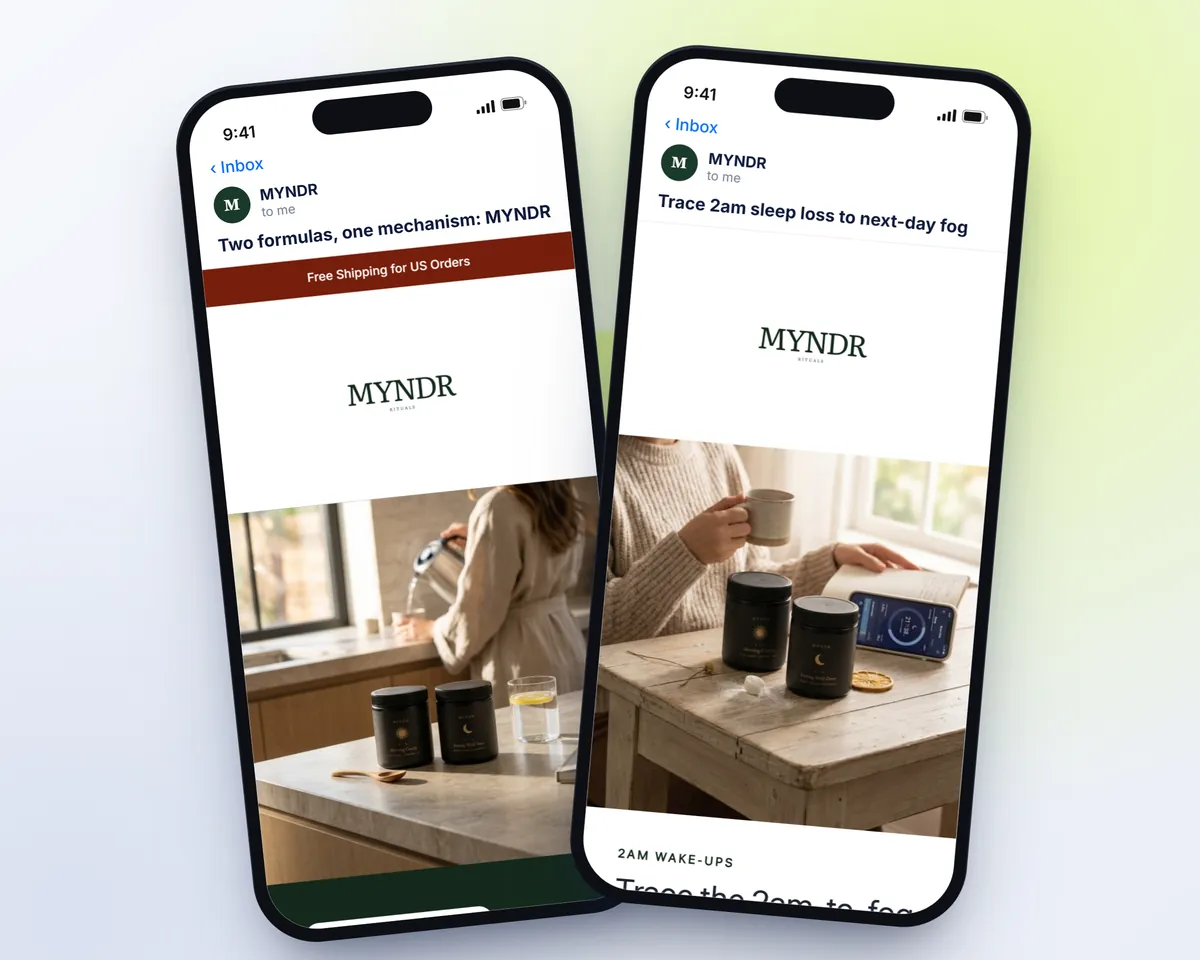
Moving from Mailchimp to a Tilly setup means moving your sending to Klaviyo, because that is where Tilly publishes today. Export your audience from Mailchimp with each contact's subscription status, import it into Klaviyo, and keep unsubscribed and cleaned addresses out of the send.
Automations do not transfer between tools. Tilly writes the core flows fresh from your audit, so list the Mailchimp automations you rely on and check each one has a replacement before switching Mailchimp off.
Plan a few weeks of overlap. Warm up the new sending domain on your most engaged contacts first, leave Mailchimp's automations running until Klaviyo's are live, then turn them off one at a time so no customer gets both.
Questions people ask
Does Tilly work with Mailchimp?
No. Tilly publishes to Klaviyo today, with Omnisend and Shopify Email next. Mailchimp is not on that list yet.
How many automations does Mailchimp allow?
Up to 4 marketing automations on Essentials and up to 200 on Standard, according to Mailchimp's Shopify listing.
Is Mailchimp free for small stores?
Under 250 contacts, yes, with sends capped at 500 a month or 250 a day on the free plan.
Can I try both before deciding?
Yes. Mailchimp offers a 14-day free trial of its Standard plan, and Tilly's audit is free and needs only your store address. Reading Tilly's welcome flow next to the one Mailchimp's editor would have you build is the quickest way to see whether the writing is the part you are missing.
Sources
- Mailchimp: mailchimp.com/pricing/marketing, checked 25 September 2026
- Mailchimp: apps.shopify.com/mailchimp, checked 25 September 2026
Spotted a price or fact that has changed? Report an error.
See this on your own store
Paste your store URL. The first pass takes about a minute and needs no account. Save a card (nothing is charged) and Tilly reads the whole store and works out who buys from you.