
Tilly vs Shoplift
Shoplift runs storefront A/B tests from inside Shopify’s theme customizer. Tilly runs your email, ads, SEO, AI search and store pages as one loop: it works out what to change, writes the fix for your approval, tests it alongside email and ad variants, and carries each winner forward. Below: what each tests, what each costs, and where Shoplift is the better choice.
The short answer
Shoplift runs split tests on your theme, launched from the Shopify customizer, without page flicker.
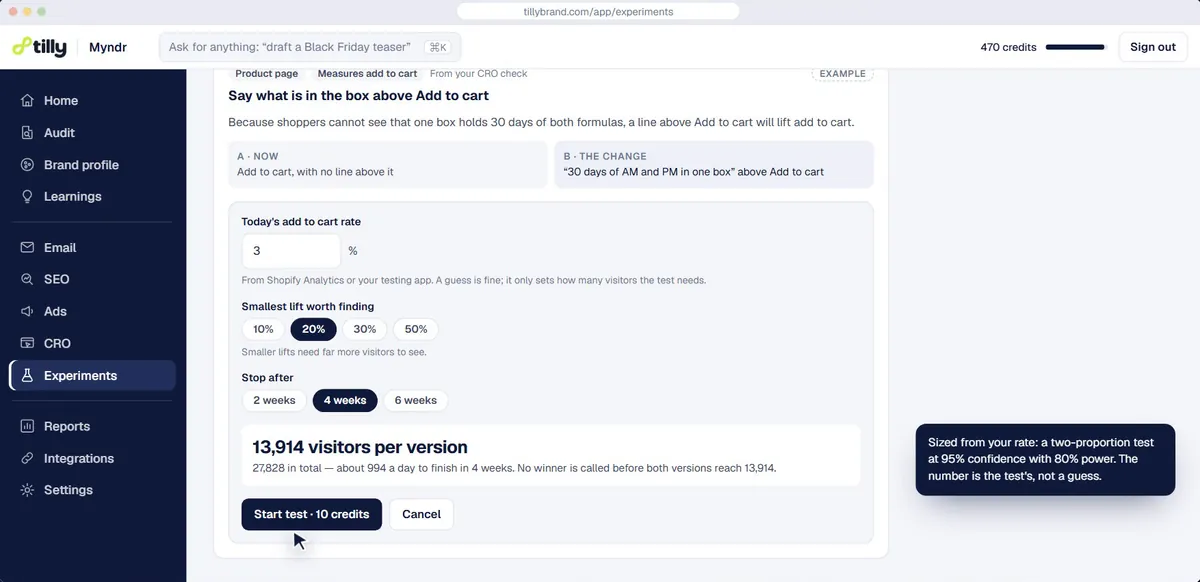
Pick Shoplift if testing your storefront is your main lever and you have the traffic. Pick Tilly if you do not yet know what to change. Tilly reads your pages and reviews, finds what stops buyers, writes the fix (product and collection text applies with one click, with Undo), plans and sizes the test and calls the winner, while a testing app such as Shoplift splits the traffic. Try the free audit: paste your store URL and see in about a minute what Tilly would fix first.
What Shoplift is
Shoplift is a split-testing app for Shopify themes, rated 4.9 out of 5 on its listing. source, checked 25 September 2026
You launch tests from inside the Shopify theme customizer, or let Lift Assist build them without code, on product pages, landing pages, collections, the homepage, prices and search. Tests run without page flicker, theme tests cover rebrands, navigation and the mini-cart, and price testing starts on the Advanced plan.
What each one does
Each app’s cells come from its own Shopify listing or pricing page, linked beside the words. “Not listed” means we did not find it there, not that the app cannot do it. Tilly’s column is our own product.
| The job | Tilly | Shoplift |
|---|---|---|
| Email and messaging | ||
| Email flows | Writes 8 flows, saved to Klaviyo as drafts | Not listed |
| Email campaigns | Writes them, saved to Klaviyo as drafts | Not listed |
| Products in emails | A featured product or a product carousel, from your catalogue | Not listed |
| SEO and AI search | ||
| SEO blog posts | Writes and publishes them to your Shopify blog | Not listed |
| SEO audit and rankings | Free audit; rankings from Search Console | Not listed |
| SEO fixes | Titles, descriptions and alt text, applied when you press Apply | Not listed |
| AI search visibility | Asks AI assistants your buyers’ questions every week | Not listed |
| Ads | ||
| Meta ads | Writes and makes them; published paused | Not listed |
| Google ads | Writes a search ad; published paused | Not listed |
| Reads past ad results | Reviews the last 30 days of your Meta account | Not listed |
| Store pages and tests | ||
| Store page fixes | Writes the fix for each page issue | Not listed |
| A/B tests | Plans and sizes them, calls the winner; does not split traffic | Runs them: pages, prices and searchsource |
| Price tests | No | From the Advanced plansource |
| Results and control | ||
| Reports | Blended ROAS and MER from Shopify, Meta and Google, every morning | Not listed |
| Learns from results | Every night, and carries a winner across channels | Not listed |
| Tracks changes to your store | Every six hours, read only | Not listed |
| Waits for your approval | Always: nothing goes live without it | Not listed |
| Connects to | Shopify, Klaviyo, Meta, Google Ads, Search Console, Google Analytics | Not listed |
Side by side
Shoplift's figures come from its pricing page and Shopify App Store listing, each cell linked and dated. Its prices depend on monthly unique visitors; we show the published plan prices and the starting prices the listing gives.
| Side by side | Tilly | Shoplift |
|---|---|---|
| Lowest published paid plan | Store: $49/month | Core: $99/monthsource |
| What the price is based on | Credits spent when an agent builds something; not contacts, sends or ad spend | Not recorded |
| Free plan or trial | 100 credits, once; on a website sign-up they arrive after a card is saved (it is not charged) | 14-day free trialsource |
| Shopify App Store rating | Not recorded | 4.9 out of 5source |
| Connects to | Klaviyo (draft flows and campaigns), Meta (paused ads), Google Ads (a paused search ad) and Shopify (SEO titles, descriptions and alt text you apply, and blog posts, hidden unless you choose live) | Checkout, Heatmap, Klaviyo, Okendo, Rebuy, Recharge, Replosource |
| Approval before anything goes live | Never. Every email, post, ad and page change waits for approval | Not recorded |
What each costs
Shoplift's Shopify listing prices Core at $99 a month, Advanced at $399 and Pro at $999, with starting prices of $74, $299 and $699 depending on site-wide monthly unique visitors, and annual billing saving up to 30%. Core covers up to 100k monthly store visitors, price testing starts on Advanced, and there is a 14-day free trial.
Tilly charges per piece of work: 20 credits for a CRO audit, 10 for each written fix and 10 for an A/B test including the variants. The Store plan is $49 a month for 500 credits, after 100 free credits, and the same credits cover email, ads and blog posts.
For a store that tests one page a month, the difference is mostly about who writes the variant. For a store testing constantly across many templates, Shoplift is the specialist and priced as one.
The last table prices the same store on both. These apps price by visitors, orders or tested users, so check each calculator for your store. Tilly does not split traffic: it plans the tests, writes the changes and calls the winner, next to a testing app rather than instead of one.
| Shoplift's published plans | Price |
|---|---|
| Core | $99/month, starts at $74, based on monthly unique visitorssource |
| Advanced | $399/month, starts at $299source |
| Pro | $999/month, starts at $699source |
| Tilly's plans | Price |
|---|---|
| Start | $0, 100 credits, once, good for 30 days |
| Store | $49/month, 500 credits every month |
| Growth | $149/month, 2,000 credits every month |
| Agency | $399/month, 6,000 credits every month, shared across clients |
| What the same store pays | A store with 50,000 visitors a month | Adding price tests |
|---|---|---|
| Shoplift | $99 a month: Core, up to 100k visitors a month (from $74 by visitors)source | $399 a month: Advanced, where price testing startssource |
| Tilly | $79 a month: starting a test is 10 credits; your testing app splits the traffic | No price tests |
Where Shoplift is better
Shoplift's advantages come first. For storefront testing, it goes further than Tilly. source, checked 25 September 2026
- Theme and template testing: whole themes for a rebrand, navigation and the mini-cart can be tested, which Tilly's experiments agent does not do.
- Price testing on the Advanced plan and above. Tilly never changes prices.
- It is built into the theme customizer and runs tests without page flicker, which matters when small changes are being measured.
- A strong App Store record: a 4.9 rating when we checked.
Where Tilly is better
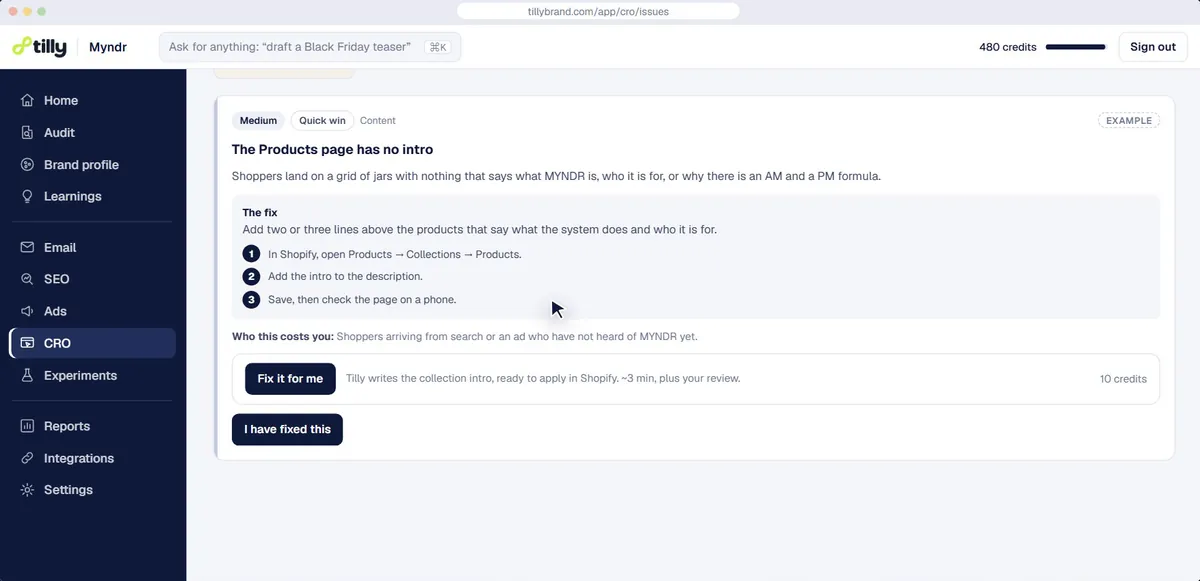
Tilly writes the change as well as testing it. The CRO agent reviews product, collection, cart and home pages, mobile first, and ties each finding to a customer and an objection from your reviews. The fix, new copy, reordered sections, trust blocks and FAQ in your customers' words, is built on a preview copy of your theme.
It learns from your own results. Every night it reads what each email, ad, post and page change earned, keeps the patterns your numbers back up, and writes the next piece with them, so a winning ad angle can become an email subject line and a product-page headline. Shoplift tells you which page version won; Tilly takes that lesson into your emails and ads as well. (How the loop works.)
It also watches two things most marketing tools miss: whether AI assistants name your store when asked your buyers' questions, the part of search now called AEO (how to get named by ChatGPT), and every change made to your theme, products, pages and menus, with what each said before and after.
It tests beyond the store. The same experiments agent tests email subject lines, content and send times in Klaviyo, and ad creative and angles in Meta, so one backlog of ideas covers every channel.
Its ideas come with reasons. Each test is written as a hypothesis naming the persona and the worry it addresses, so a win tells you why, and the result is written into your brand profile for the next email, ad or page fix to use.
It calls winners conservatively, with a minimum sample, a maximum run time and one primary metric set in advance, and it says plainly when a test did not gather enough data.
It starts before a test is needed. Small, low-risk fixes can ship straight from the preview theme without a test at all, which matters for stores whose traffic would take months to reach a result.
Switching
You can run both. Shoplift can keep testing themes and prices while Tilly's CRO agent writes fixes, but avoid two tools testing the same page at once, or neither result is clean.
If you move page tests to Tilly, end live Shoplift experiments first and apply the winners you want to keep, so the live theme reflects them before Tilly's CRO audit reads it.
Start with Tilly's free store audit, then a CRO audit on the page that matters most. Small, low-risk fixes can ship straight from the preview theme; bigger ones become tests with the hypothesis written.
If price tests are part of your plan, keep a tool that supports them. Tilly will not replace that part of Shoplift.
Questions people ask
Can Tilly test Shopify themes or prices?
No. Tilly tests page copy and layout on a preview copy of your theme, plus emails and Meta ads. Shoplift tests whole themes and, from the Advanced plan, prices.
How is Shoplift priced?
By site-wide monthly unique visitors. Its Shopify listing shows Core at $99 a month, Advanced at $399 and Pro at $999, with a 14-day free trial.
Will Tilly change my live theme?
Not without a second approval. Fixes go to an unpublished copy of your theme for you to preview; making them live is a separate step.
Can Tilly build test variants without code like Lift Assist?
Tilly's CRO agent writes the copy and section changes and builds them on a preview copy of your theme, so no code is needed on your side. It does not swap whole themes or templates, which Shoplift does.
Sources
- Shoplift: apps.shopify.com/shoplift, checked 25 September 2026
- Shoplift: shoplift.ai/pricing, checked 25 September 2026
Spotted a price or fact that has changed? Report an error.
See this on your own store
Paste your store URL. The first pass takes about a minute and needs no account. Save a card (nothing is charged) and Tilly reads the whole store and works out who buys from you.